A feasibility study is a critical analytical tool used by healthcare professionals and entrepreneurs to determine the technical, operational, and economic viability of a proposed business venture. For a chiropractic clinic in North Vancouver, this study serves as the foundational research required to justify the allocation of capital and resources. It provides an objective assessment of whether the project should proceed, be modified, or be abandoned. David Howse from Feasibility First, a feasibility study consultant based in Calgary, Alberta provided the following information.
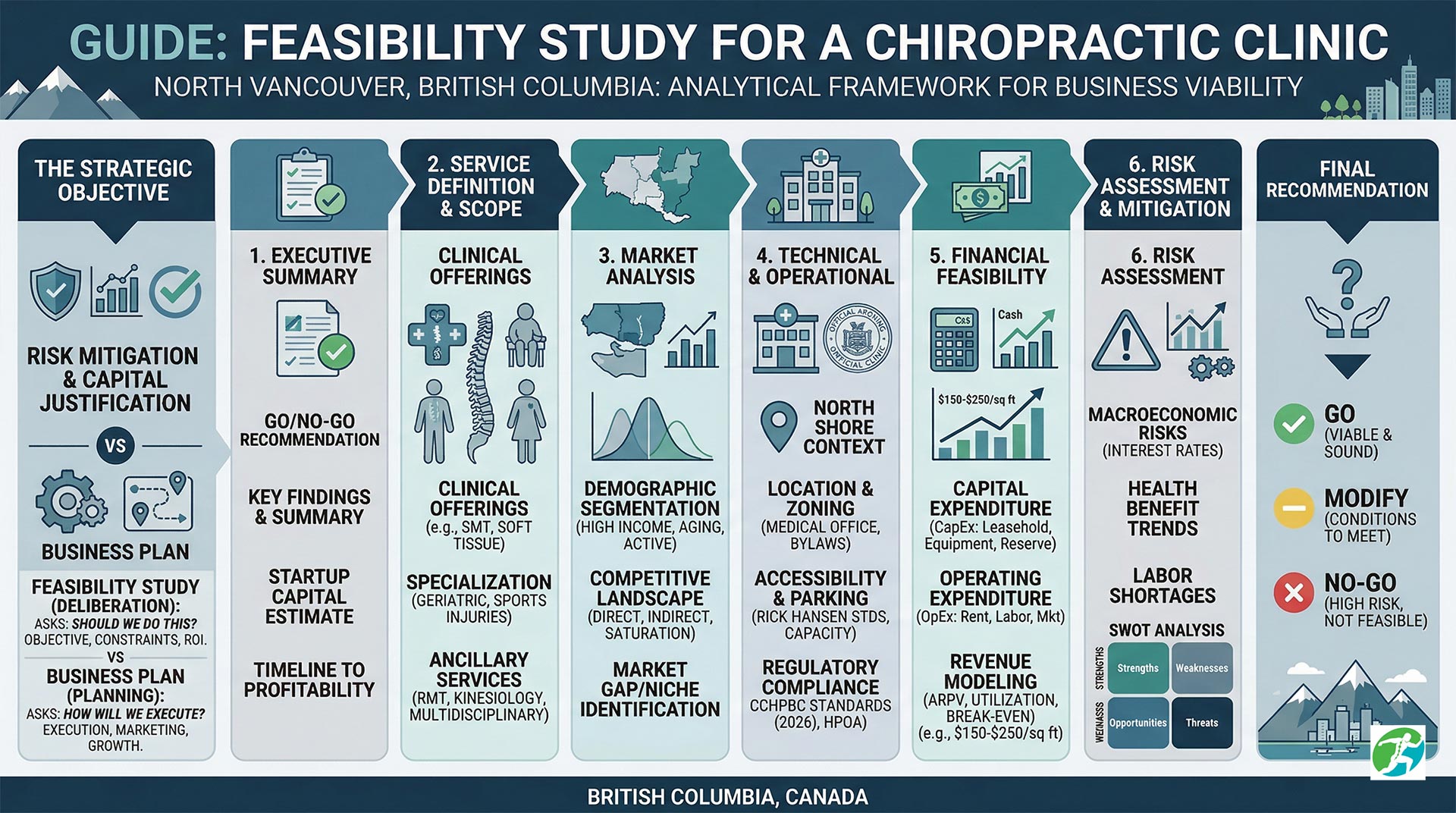
The Strategic Importance of the Feasibility Study
The primary objective of a feasibility study is to mitigate risk. In a high-cost real estate market such as North Vancouver, the margin for error is narrow. Establishing a clinical practice without a rigorous evaluation of the market and financial requirements can lead to significant capital loss.
Specifically, the study allows the practitioner to:
- Assess Market Saturation: Determine if the density of existing chiropractic and multidisciplinary clinics in areas like Lower Lonsdale or Lynn Valley permits the entry of a new provider.
- Determine Financial Viability: Identify the “break-even” point where patient volume offsets the high overhead costs associated with British Columbia’s Lower Mainland.
- Identify Regulatory Barriers: Ensure compliance with the evolving regulatory landscape in BC, particularly following the full implementation of the Health Professions and Occupations Act (HPOA).
Distinction Between a Feasibility Study and a Business Plan
While often confused, these documents serve distinct purposes in the lifecycle of a business.
- The Feasibility Study is conducted during the “deliberation” phase. Its primary question is: Should we proceed with this project? It is an investigative report that identifies constraints, potential ROI, and market demand. It is intended to be an objective, even skeptical, analysis of the project’s chances of success.
- The Business Plan is developed during the “planning” phase, after the feasibility study has confirmed the project is viable. Its primary question is: How will we execute this project? It serves as a roadmap for management and a promotional tool for investors, outlining marketing strategies, operational workflows, and growth targets.
Components of the Feasibility Study
1. Executive Summary
The executive summary provides a high-level overview of the study’s findings. While it appears at the beginning of the document, it is written last. It must concisely state the clinic’s value proposition, the total estimated startup capital required, the projected timeline to profitability, and the final recommendation on whether to proceed.
2. Service Definition and Scope of Practice
This section defines the clinical model. In the 2026 healthcare environment, chiropractic care is increasingly integrated into broader wellness models.
- Clinical Offerings: Detail the specific modalities to be offered (e.g., spinal manipulative therapy, soft tissue therapy, or rehabilitative exercise).
- Specialization: Identify if the clinic will target specific demographics, such as geriatric care, pediatric care, or sports-related injuries common to the North Shore’s active population.
- Ancillary Services: Evaluate the feasibility of a multidisciplinary approach, including Registered Massage Therapy (RMT) or Kinesiology, which are often high-demand services in North Vancouver.
3. Market Analysis: The North Vancouver Context
A thorough market analysis is essential to understand the competitive and demographic landscape.
Demographic Segmentation North Vancouver has a unique demographic profile characterized by high household income and an aging but active population. The study should analyze:
- Population Growth: Review census data for the City and District of North Vancouver to identify high-growth corridors (e.g., the Maplewood Innovation District or the Seylynn area).
- Patient Avatar: Define the primary patient. On the North Shore, this often includes high-income professionals with extended health benefits and retirees focused on mobility and longevity.
Competitive Analysis Identify all direct and indirect competitors within a five-to-ten-kilometer radius.
- Direct Competitors: Established chiropractic clinics.
- Indirect Competitors: Physiotherapy clinics, osteopaths, and multidisciplinary wellness centers.
- Market Gap: Identify underserved niches. For example, if existing clinics in the Lonsdale corridor have three-week wait times, there is a clear opportunity for a new entrant.
4. Technical and Operational Feasibility
This section assesses the physical and logistical requirements of the clinic.
Location and Zoning North Vancouver has specific municipal bylaws regarding “Medical Office” zoning. The study must confirm that potential locations are zoned correctly to avoid costly delays in obtaining business licenses. Considerations include:
- Accessibility: Proximity to transit hubs (such as the Lonsdale Quay) and compliance with the Rick Hansen Foundation Accessibility Standards.
- Parking: Adequate parking is a frequent challenge in North Vancouver; the study must quantify the required parking stalls based on projected patient volume.
Regulatory Compliance As of 2026, the College of Complementary Health Professionals of British Columbia (CCHPBC) governs chiropractic practice. The study must detail the costs and requirements for:
- Maintaining licensure under the Health Professions and Occupations Act (HPOA).
- Adhering to updated 2026 privacy standards regarding Electronic Health Records (EHR) and patient data storage in BC.
5. Financial Feasibility and Projections
The financial analysis is the most critical component for securing financing. It must include three primary statements:
Capital Expenditure (CapEx) Quantify the initial investment required, including:
- Leasehold Improvements: Costs for plumbing, electrical, and partitioning treatment rooms in North Vancouver commercial spaces (currently ranging from $150 to $250 per square foot).
- Medical Equipment: Specialized tables, diagnostic imaging (if applicable), and rehabilitative tools.
- Working Capital: A reserve of at least six months of operating expenses to cover the initial ramp-up period.
Operating Expenditure (OpEx) Estimate monthly costs, including:
- Commercial Rent: North Vancouver rates vary by neighborhood, with premium Lonsdale frontage commanding significant triple-net (NNN) costs.
- Labor: Competitive salaries for office administrators and commission splits for associate practitioners or RMTs.
- Marketing: Costs for SEO, local digital advertising, and community outreach.
Revenue Modeling Project revenue based on:
- Average Revenue Per Visit (ARPV): Based on current BC Chiropractic Association fee guidelines.
- Utilization Rate: Projected number of patients per day.
- Break-Even Point: The specific date or patient volume at which the clinic becomes self-sustaining.
6. Risk Assessment and Mitigation
Every venture faces internal and external risks. This section identifies these threats and proposes strategies to manage them.
- Macroeconomic Risks: Fluctuations in interest rates affecting debt servicing for equipment loans.
- Health Benefit Trends: Changes in how major insurers (e.g., Pacific Blue Cross, Sun Life) reimburse chiropractic services.
- Labor Shortages: The difficulty of hiring and retaining qualified administrative and clinical staff in a high-cost-of-living area.
7. SWOT Analysis
A SWOT analysis (Strengths, Weaknesses, Opportunities, Threats) provides a strategic summary of the clinic’s position within the North Vancouver market.
- Strengths: Specialized expertise, modern technology, or a high-visibility location.
- Weaknesses: Limited brand recognition or high initial debt.
- Opportunities: Partnerships with local North Shore sports organizations or corporate wellness contracts with local tech firms.
- Threats: New market entrants or restrictive changes in provincial health policy.
8. Final Recommendation
The study must conclude with a definitive statement regarding the project’s viability.
- Go: The project is financially and operationally sound; proceed to the development of a formal business plan.
- Modify: The project is viable only if certain variables change (e.g., finding a location with lower rent or shifting the service model to include more multidisciplinary practitioners).
- No-Go: The market is saturated, or the financial risks outweigh the potential returns.
A feasibility study for a chiropractic clinic in North Vancouver is an essential exercise in professional due diligence. By systematically evaluating the market, financial requirements, and regulatory environment, the practitioner can move forward with a high degree of confidence or pivot their strategy before significant capital is committed. In a sophisticated and competitive market like the North Shore, data-driven decision-making is the most reliable predictor of long-term clinical success.